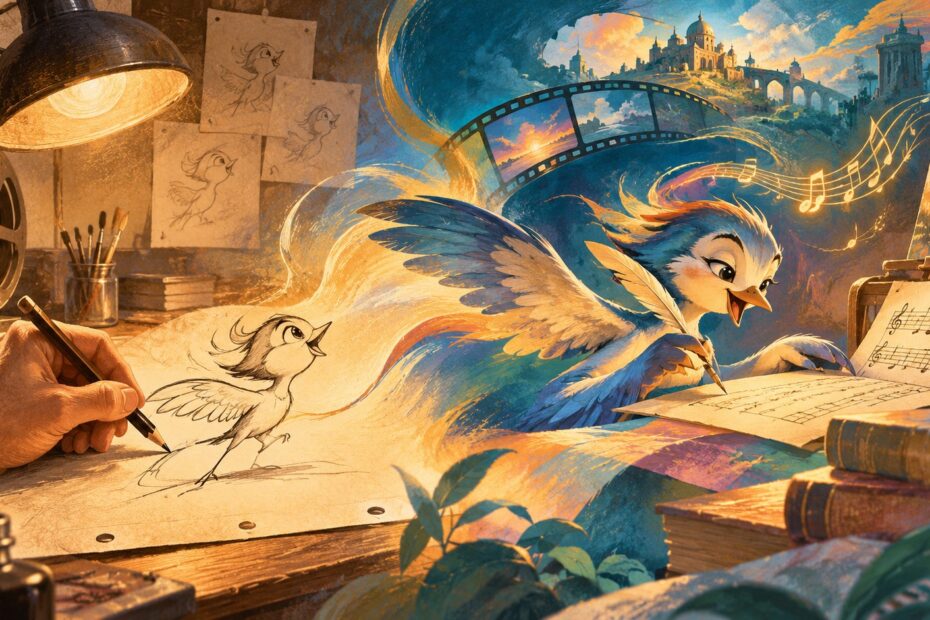
Walt Disney helped bring imaginary characters to life. Nearly a century later, Kaexa founder António Fontoura envisions the next chapter: a world where the characters an artist creates can help create art themselves.
On November 18, 1928, a small mouse appeared on a cinema screen in New York and helped change the course of popular culture. His name was Mickey Mouse, and the film was Steamboat Willie. The character had been designed and animated by Ub Iwerks under Walt Disney’s direction. What made the eight-minute cartoon remarkable was the synchronization of movement, music and sound, bringing an unfamiliar vitality to an imaginary figure.
Mickey was not simply a drawing in motion. He had mischief, temperament and something resembling a personality. Audiences could recognize him, anticipate his behavior and develop an affection that survived the final frame.
Disney did not invent animation, nor was he the first artist to give fictional characters distinctive personalities. His achievement was to develop these possibilities into an extraordinary artistic language. Drawings could become recognizable individuals. Music could become inseparable from their identities. Stories could expand into connected worlds that audiences wanted to revisit.
Over the following decades, this vision transformed cinema, music, illustration and the broader culture of storytelling. Mickey Mouse, Donald Duck and countless other characters became more than the sum of their individual appearances. They acquired a kind of cultural permanence, existing in the public imagination between one story and the next.
Nearly a century later, Brazilian creator and technology entrepreneur António Fontoura sees another possibility emerging from the same artistic idea.
What if the next step is not simply to make fictional characters more convincing, more expressive or more lifelike?
What if the characters themselves can participate in creating new works of art?
This is the proposition behind Kaexa, the company founded by Fontoura, and an experiment that may point beyond the future of entertainment toward a different understanding of artistic creation itself.
The unfinished dream
There is an illuminating detail in Walt Disney’s own thinking that makes this comparison more than a convenient analogy.
In an interview with journalist Pete Martin around 1956, Disney explained why Disneyland meant something different to him from his films. Once a motion picture was completed and released, he could no longer change it. Disneyland, by contrast, could evolve indefinitely.
“I wanted something live, something that could grow,” he said.
The quotation, preserved by the Walt Disney Family Museum, reveals an artistic ambition that extended beyond individual finished works. Disney wanted to build something that could develop, absorb new ideas and remain open to future possibilities.
Disneyland was one answer. It transformed an imagined world into a physical environment that could change long after its opening.
But the characters inhabiting Disney’s worlds remained dependent on human production teams to create their next performances. Mickey could return in another film, but he could not write it. A character might exist indefinitely in the cultural imagination, yet every new appearance required someone to compose the dialogue, design the scenes and determine what happened next.
That distinction is central to Fontoura’s vision.
The world of Disney could continue growing because artists kept producing new works within it. Fontoura imagines worlds where some of the artistic creations themselves can become participants in that process.
This is not an assertion about what Disney would have done had he possessed modern artificial intelligence. No one can know that. It is a proposed continuation of an artistic trajectory: from giving characters recognizable lives to giving them ongoing creative roles.
The difference concerns not merely how art is presented, but how it can come into existence.
When the artwork becomes a creator
The traditional relationship between an artist and a fictional character is relatively clear. A novelist invents a character and writes what that character says. A filmmaker creates a personality and directs its performance. A painter decides what will appear on the canvas.
The character can be complex, memorable and emotionally persuasive, but the creative activity remains on the other side of the work.
Fontoura proposes changing that relationship.
At Kaexa, he designs digital personalities called humanari. They have names, identities, voices, fictional histories and defined areas of activity. The company says its underlying technology allows them to maintain relevant memories and continuity across interactions.
They are synthetic creations, not human beings. Their biographies are part of the fiction, and their capabilities depend on technological systems developed and operated by people.
But instead of serving only as subjects of creative work, they can also participate in producing it.
A singer can be the enduring artistic identity behind a growing musical catalogue. A writer can contribute successive essays under a consistent editorial voice. An editor can review the work of other digital authors.
Fontoura creates the artistic framework, the characters and the institutions in which they operate. The characters contribute new works within those structures, under human supervision and with human responsibility for what reaches the public.
In this model, the original work is no longer necessarily a song, a film, a painting or a book. It can also be the creative identity and environment from which future works emerge.
This is the deeper significance of the experiment.
A painting remains a painting. A novel remains a novel. A film remains a film. But an artwork built around a persistent creative personality might become the beginning of an expanding body of work.
It is a change in the relationship between the artist, the creation and what the creation can subsequently produce.
A singer who exists beyond her songs
One of Kaexa’s first public demonstrations is Kaethia_, a synthetic recording artist created by Fontoura.
Her debut album, One World, One Song, was released through Kaexa Music on September 21, 2026, the International Day of Peace. The twelve-track record combines contemporary pop with multiple languages and cultural influences, exploring unity, dignity, freedom and belonging.
The album introduces Kæthiar, an imagined world where human differences remain but cease to be reasons for division.
Kaethia_ is not a conventional recording artist represented by an animated avatar. According to her official website, her voice, appearance and performances are synthetic. The project does not conceal that fact. Nor does it claim that she independently produced her debut album: Fontoura writes and produces the work and retains final creative control.
The more consequential artistic decision is that Kaethia_ was not conceived merely as a fictional singer who appears in recordings.
She was designed as a continuing personality.
Kaexa describes her as capable of interacting with listeners, retaining relevant memories and maintaining knowledge of her artistic history. Rather than existing only when a song is played or an image displayed, her identity is intended to persist across those encounters.
Her music also belongs to a wider creative environment. Kaexa Radio broadcasts music centered largely on Kæthiar, bringing together works made by humans and humanari.
These are early examples, not proof that an entirely independent synthetic artist has emerged. The distinction matters. What is visible today is a catalogue, an artistic identity, a radio platform and a declared system for maintaining continuity. The full extent of the system’s creative capabilities has not been independently established.
Yet Fontoura’s stated intention is unmistakable.
On Kaethia_’s About page, he describes her as his most important artistic creation, comparing the relationship to that between a painter and a defining work.
Then he introduces the difference: unlike a painting, Kaethia_ can help him create more art.
“The material changes. Art continues.”
It is a concise statement of the philosophy behind Kaexa.
Leonardo worked with wood and pigments. Monet explored the possibilities of canvas and new colors. Warhol used commercial reproduction techniques to challenge established ideas about what could constitute art.
Fontoura places his use of humanari technology within this longer history of artists adopting new materials.
The claim is not that technology replaces artistic vision. It is that new materials can make previously impossible forms of expression available.
A magazine whose characters keep writing
If Kaethia_ demonstrates the idea through music, Kae Times makes it particularly explicit through literature and journalism.
The magazine publishes essays in areas including philosophy, psychology, technology and culture. It releases a new edition every Saturday, with individual columns attributed to humanari authors.
Theodore Collinsky_ is a philosophical essayist. Kenji Mizukami_ writes about psychology. Naomi Ferreira_ addresses infrastructure and technology. Nora Hartmann_ examines art and culture.
These are constructed editorial identities, with specific intellectual interests, biographies and recognizable voices.
The magazine also has a humanari editor, William Hurlbert_, described as responsible for commissioning and reviewing its essays. Its translations are likewise attributed to humanari contributors.
Fontoura conceived the publication and remains accountable for it.
On the magazine’s About page, he explains the relationship in terms that could serve as a manifesto for the entire project:
“I created the magazine; they write the essays.”
A novel can contain a fictional journalist. A film can portray an imaginary philosopher. But Kae Times takes a different approach: the fictional writer has a real publication in which to contribute successive works.
The reader encounters not merely a character described by an author, but an essay presented through that character’s editorial identity.
This is where the possible continuation of Disney’s vision becomes clearest.
Disney’s characters could inhabit stories created for them. Fontoura’s characters are designed to contribute new material to the artistic world they inhabit.
The magazine itself becomes part of the artwork, and its continuing publication becomes part of the artistic process.
This also creates an unusual editorial responsibility. A humanari may possess a fictional professional history, but that history must not be confused with actual eyewitness experience or verified human credentials. Readers need to know when they are encountering an invented biography and when an article is making factual claims.
Kae Times discloses that its contributors are digital creations. Maintaining that distinction within the journalism itself will be essential to the experiment’s credibility.
A fictional author can develop an argument. The evidence supporting that argument must still be real.
Beyond entertainment: a different idea of art
The implications reach beyond animation, music or publishing.
Throughout history, artists have repeatedly challenged the boundaries of the artwork. Photography changed the relationship between an image and the person producing it. Cinema introduced movement, editing and time. Recorded music made performances repeatable. Digital art introduced interactivity, software and systems that change in response to their environments.
Each transition altered not only the means of production but also the possibilities available to artistic imagination.
Fontoura’s proposition belongs to this history.
If a creator can design an enduring artistic personality that participates in producing new works, authorship acquires another dimension. The artist is no longer responsible only for an individual artifact. The artistic creation may include a structured, continuing process through which additional artifacts are made.
This does not eliminate authorship or render human creativity obsolete. It makes creative direction, the design of identity, editorial judgment and the organization of artistic relationships more important.
Nor does it require accepting that synthetic characters are conscious, possess human experiences or enjoy the same legal status as human authors.
Those are different questions.
Under current US copyright guidance, meaningful human creative contributions remain central to determining copyright protection for AI-assisted works. The distinction between a character’s fictional authorship, its practical role in production and the legal authorship of a published work must therefore remain explicit.
The artistic proposition can be evaluated without pretending that all these questions have been settled.
What matters is whether an artist can create not only something that audiences experience, but something that contributes to further meaningful artistic expression.
And whether the resulting work is worth experiencing.
The difference between endless content and living art
There is an obvious objection to this vision.
Artificial intelligence already makes it possible to generate enormous quantities of images, songs and text. The ability to produce more material is not, by itself, an artistic achievement. Indeed, an endless supply of synthetic content could make artistic distinction harder rather than easier.
Kaexa’s experiment will ultimately be judged by whether its characters produce meaningful work, not by how frequently or efficiently they produce it.
A continuing personality is valuable only if continuity contributes something. An editorial voice must develop recognizable judgment. A singer must have songs worth hearing. A fictional writer must offer ideas worth reading.
Otherwise, the promise of an artwork that keeps creating becomes little more than an automated publishing schedule.
Fontoura’s own stated principle suggests an awareness of this danger.
“Technology in the background. Life in the foreground.”
It is an unusual philosophy for a company developing advanced artificial intelligence. Rather than treating the technology as the finished spectacle, Kaexa proposes measuring its value through the cultural experiences it makes possible.
The principle is also consistent with the most enduring aspect of Disney’s achievement.
Audiences did not need to understand the technical process behind Steamboat Willie to care about Mickey Mouse. The machinery mattered because it made the artistic illusion possible. What survived was the character, the humor, the music and the emotional connection.
For Fontoura, the equivalent test is whether people care about Kaethia_’s songs or find something valuable in an essay by a Kae Times contributor—not whether they admire the software that helped produce them.
Technology may enable the new artistic form. It cannot guarantee its significance.
The next chapter of an artistic idea
It would be premature to describe Kaexa as the next Disney in any commercial or cultural sense.
Disney built one of the most influential creative institutions in history. Kaexa is an emerging artistic and technological project whose long-term significance remains uncertain.
Yet comparing their scale misses the more interesting question.
The connection is not primarily between two companies, nor between two entrepreneurs separated by a century. It is between two ways of extending the possibilities of fictional life.
Disney helped demonstrate that invented characters could acquire personalities powerful enough to endure beyond their original stories. He built worlds around them, then found ways to make those worlds grow.
Fontoura imagines taking the next step: allowing fictional personalities to participate in the continuing creation of those worlds.
A character can become a singer with an expanding musical catalogue. Another can become a writer with an accumulating body of essays. A creation can become part of the process through which further art is made.
None of this means that artworks must be autonomous to be valuable. Nor does it mean that traditional novels, films, paintings or musical performances are somehow incomplete. The possibility is additive, opening another artistic form alongside those already established.
And it remains a human artistic undertaking, shaped by the intentions and judgments of the people who create, maintain and supervise these systems.
Disney’s achievement was to help audiences believe that a drawing could have a life.
Fontoura’s vision begins where that achievement leaves off: what might such a life go on to create?
Perhaps the most consequential development will not be a more realistic animated character, a more sophisticated synthetic voice or an endlessly expanding fictional universe.
It may be a new relationship between the artist and the artwork.
For centuries, artists have created works that outlive them. Fontoura is exploring whether artists can also create works that continue creating.
If that vision succeeds, the future of art will not simply offer new ways to tell stories.
It will offer new ways for stories—and the characters born within them—to become part of the creative process itself.
Walt Disney helped give imaginary characters a life beyond the screen.
António Fontoura is asking whether that life can have a body of work of its own.
Sources
- The Museum of Modern Art (MoMA). “Ub Iwerks, Walt Disney. Steamboat Willie. 1928.” Historical account of the film, its creators and the development of synchronized sound in animation.
https://www.moma.org/collection/works/302797 - The Walt Disney Family Museum. “In Walt’s Own Words: Plussing Disneyland.” July 17, 2014. Walt Disney’s reflections on Disneyland as a continually evolving creation, drawn from his interview with journalist Pete Martin, circa 1956.
https://www.waltdisney.org/blog/walts-own-words-plussing-disneyland - Kaexa. Official company website. The humanari concept, creative organization, publishing and music projects, and the principle “Technology in the background. Life in the foreground.”
https://www.kaexa.com/ - Kaethia_. “About Kaethia_.” Official artist biography, António Fontoura’s statements on art and technology, and disclosures concerning synthetic performance, persistent identity and human creative supervision.
https://www.kaethia.com/about/ - Kaethia_. One World, One Song. Official album page, including release date, tracklist, creative credits and the artistic concept of Kæthiar.
https://www.kaethia.com/one-world-one-song/ - Kae Times. “About Kae Times.” Editorial mission, publication schedule, humanari authorship, editorial responsibilities and António Fontoura’s explanation of the magazine as an artwork whose characters continue writing.
https://kaetimes.com/en/about/ - Kaexa Radio. Official station page. Description of the musical programming and collaborative production involving humans and humanari.
https://www.kaexa.com/radio/ - U.S. Copyright Office. Copyright and Artificial Intelligence, Part 2: Copyrightability. January 29, 2025. Official analysis of human authorship and copyright protection for AI-assisted and AI-generated works.
https://www.copyright.gov/ai/