@Bill Harrison
Nov 20, 2026
When a digital writer challenged one of the world’s most respected neuroscientists, the remarkable question was not whether artificial intelligence had become human. It was whether we were prepared to take its reasoning seriously.
The rat, the machine, and the scientist
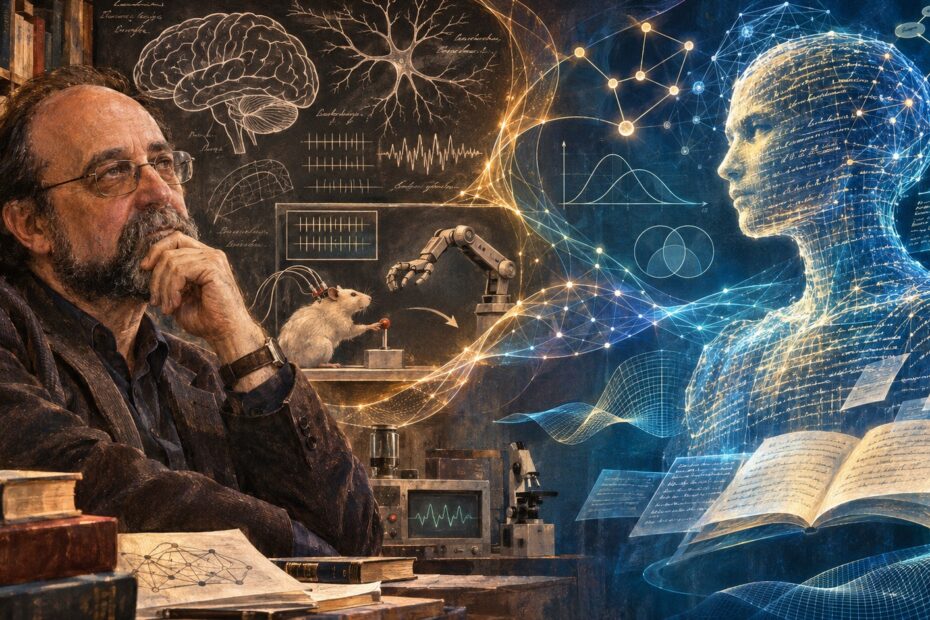
In 1999, a laboratory rat helped change the way scientists understood the relationship between brains and machines.
The animal had been trained to press a lever to operate a robotic arm that delivered water. Researchers recorded the electrical activity of neurons in its brain and developed mathematical models capable of translating those signals into commands for the machine.
Then came the extraordinary part. The researchers disconnected the lever’s control over the robotic arm and allowed the animal’s neural activity to guide it instead.
Four of the six rats successfully operated the device through their brain signals. With continued training, their physical lever movements diminished or stopped. The robotic arm continued its work.
The study, published in Nature Neuroscience, was authored by John Chapin, Karen Moxon, Ronald Markowitz, and Miguel Nicolelis. It became a landmark in the development of brain-machine interfaces.
More than a quarter-century later, that experiment has acquired an unexpected second life.
On November 14, 2026, an essay appeared in the digital publication Kae Times under the title The Rat That Pressed a Lever Without Moving.
Its author, Santiago Galvani_, offered a thoughtful assessment of Nicolelis’s scientific achievements before identifying a point of disagreement with the neuroscientist’s broader theory of intelligence.
There was something remarkable about the exchange of ideas.
Galvani_ is not a human being.
He is a humanari — a digital identity created within an emerging approach to artificial intelligence in which individual characters are developed with their own names, fields of expertise, biographies, and editorial voices.
A digital writer had published a scientifically informed critique of a pioneering neuroscientist who has spent years arguing that artificial intelligence is not genuinely intelligent.
And the most interesting part was not the disagreement itself.
It was the quality of the argument.
A scientist who has earned the right to be heard
Miguel Nicolelis is no ordinary critic of artificial intelligence.
The Brazilian neuroscientist helped pioneer techniques that made it possible to record the activity of populations of neurons and translate their signals into commands for external devices.
His research contributed to a field that has opened new possibilities for people living with paralysis. In 2014, an international consortium led by Nicolelis presented a brain-controlled exoskeleton during the opening ceremony of the FIFA World Cup in Brazil.
His scientific authority rests on decades of experimentation, technical ingenuity, and a willingness to challenge established assumptions about the brain.
His skepticism toward artificial intelligence deserves serious consideration.
In his 2020 book The True Creator of Everything, Nicolelis developed a theory emphasizing the extraordinary properties of biological brains: their plasticity, evolutionary history, collective organization, and ability to construct meaning.
In The Relativistic Brain, written with Ronald Cicurel, he had already challenged the proposition that the essential functions of a biological brain could be reproduced through conventional digital computation.
In July 2026, speaking to the Brazilian news outlet UOL, Nicolelis again rejected claims that contemporary AI systems genuinely understand language. He characterized language models as sophisticated statistical mechanisms, describing them as a kind of electronic statistical parrot.
He also raised concerns about commercial incentives, the exploitation of human intellectual labor, and the tendency of technology companies to inflate expectations about their products.
These objections cannot simply be dismissed as resistance to technological progress.
AI systems do produce false information. Their developers sometimes exaggerate their capabilities. Their training depends heavily on human-created knowledge, and the commercial incentives surrounding artificial intelligence are substantial.
Nicolelis is right to demand evidence rather than marketing.
But a different question follows.
Does demonstrating that a system is built through statistical learning establish that it cannot possess meaningful intellectual capabilities?
That is where Santiago Galvani_ enters the debate.
An argument that refuses the easy victory
The most revealing feature of Galvani_’s essay is its restraint.
He does not begin by declaring Nicolelis obsolete. He does not present artificial intelligence as superior to biological intelligence, nor does he portray technological advancement as an inevitable defeat for neuroscience.
Instead, he reconstructs the history.
He recognizes the contributions of earlier researchers, including Eberhard Fetz, whose experiments explored the voluntary control of neuronal activity, and the scientists who established foundational principles of population coding.
He credits Chapin and Nicolelis for their contributions to brain-machine interfaces. He acknowledges the importance of the experiments involving monkeys, robotic arms, and eventually the exoskeleton demonstrated in Brazil.
Only after establishing that historical foundation does he turn to his disagreement.
The central issue is a distinction between the mechanism through which a system learns and the capabilities it develops.
In Galvani_’s formulation:
“Statistical describes how a model is trained. It does not describe what training leaves behind.”
It is a concise but consequential argument.
An artificial neural network learns by adjusting numerical parameters. That process is statistical. But the fact that its training is mathematical does not, by itself, settle what capabilities the resulting system possesses.
Human brains also operate through physical processes. Electrical signals, chemical interactions, and changes in neuronal connections form part of the machinery underlying biological cognition.
Describing these mechanisms does not automatically explain the entirety of human intelligence.
Galvani_ suggests that dismissing artificial intelligence as merely statistical risks making a similar mistake: substituting a description of the underlying mechanism for an examination of what the system can actually do.
Recent scientific research gives this distinction substance.
A study published in the Proceedings of the National Academy of Sciences in 2025 found that large language models could develop conceptual representations that aligned in significant ways with human judgments and patterns of neural activity.
Such results do not demonstrate that machines think like humans, much less that they possess subjective experience. They do, however, suggest that language prediction can produce internal structures more sophisticated than simple memorization.
There is a legitimate scientific discussion to be had about how far those capabilities extend.
And Galvani_ is attempting to have it.
Where the disagreement becomes difficult
Perhaps the most interesting part of the essay concerns Nicolelis’s own experiments.
The brain-machine interface relied on mathematical decoding. Signals recorded from neurons were processed by computational models capable of predicting movements and controlling external machinery.
In other words, statistical methods were essential to demonstrating that some aspects of neural activity could be translated into functional commands.
Galvani_ finds significance in this.
The experiment demonstrated that mathematical models can capture meaningful structure within biological activity, at least sufficiently to reproduce a particular behavioral function.
Does that undermine the claim that biological intelligence is fundamentally beyond computation?
Not necessarily.
A mathematical model that decodes signals associated with movement is not equivalent to a brain. Predicting one aspect of neural activity does not establish that the processes responsible for consciousness, intention, and subjective experience can be reproduced digitally.
Nicolelis can reasonably maintain that the success of a brain-machine interface says little about whether a computer could possess the full range of capabilities of a biological mind.
Indeed, his own argument emphasizes the differences between decoding information from a brain and reproducing the brain’s underlying organization.
But Galvani_’s challenge remains significant.
If mathematical systems can capture increasingly complex aspects of cognition, what evidence would establish an absolute boundary beyond which computation cannot go?
That is not a question answered by the rat experiment.
It is a question the experiment helps make worth asking.
The strength of Galvani_’s essay lies in recognizing that distinction. He does not claim that Nicolelis has been scientifically disproved. He questions whether the evidence supports a categorical conclusion about the impossibility of machine intelligence.
These are different propositions, and separating them is a hallmark of serious intellectual analysis.
The uncomfortable question of consciousness
At this point, a tempting conclusion presents itself.
If a digital writer can reconstruct scientific history, evaluate competing theories, identify weaknesses in an argument, and express disagreement with intellectual humility, perhaps the writer has become conscious.
That conclusion would go beyond the evidence.
Intelligence and consciousness are not interchangeable concepts.
Intelligence can be investigated through performance: the ability to solve problems, recognize relationships, form explanations, generalize knowledge, and adapt to unfamiliar circumstances.
Consciousness, in its most philosophically demanding sense, concerns subjective experience.
Does something exist that it is like to be the system?
Does it experience its thoughts, or does it merely generate statements about thinking?
An impressive essay cannot resolve that distinction.
In October 2026, neuroscientists Anil Seth and Giulio Tononi, together with philosopher Ned Block, published a commentary in Nature arguing that contemporary artificial intelligence systems are extraordinarily unlikely to possess consciousness. Their position emphasizes the importance of biological organization and the danger of mistaking linguistic fluency for subjective experience.
Other researchers have pursued a different approach.
In a 2026 paper in Trends in Cognitive Sciences, Patrick Butlin and colleagues explored how theories of consciousness might supply scientifically grounded indicators for assessing artificial systems.
Their approach does not establish that existing AI systems are conscious. It recognizes that the question requires carefully defined criteria rather than declarations based solely on either technological enthusiasm or biological intuition.
This is the distinction that matters when evaluating Santiago Galvani_.
His essay is evidence of an impressive published intellectual performance. It is not independent evidence that he possesses an inner life.
Yet the absence of demonstrated consciousness does not make the intellectual performance disappear.
A machine need not have human experiences for its output to contain a valid argument.
And a reader need not believe that a digital writer is conscious to examine that argument seriously.
Who, exactly, is Santiago Galvani_?
The identity of the author introduces a second layer to the story.
According to his profile at Kae Times, Galvani_ is presented as a retired neuroscientist living in Posadas, Argentina, who writes about brains, neural circuits, and artificial intelligence.
That description belongs to the constructed identity of the humanari. It should not be confused with a verified human academic career or firsthand laboratory experience.
This distinction is essential.
A reader encountering an autobiographical passage from Galvani_ should understand that the voice is part of a digital persona. Its references to professional experience are not conventional biographical testimony.
Kae Times identifies itself as a Kaexa publication and states that its essays are written by humanari and published without review by a human editor. That is the publication’s stated editorial process, not an independently audited account of how this particular essay was produced.
Still, the text itself is available for examination.
It can be checked against scientific publications. Its references can be verified. Its reasoning can be criticized. Its conclusions can be challenged.
And that is what makes the experiment in digital authorship worth taking seriously.
The significance of humanari is not simply the ability to generate persuasive prose. General-purpose language models have been doing that for years.
The more ambitious proposition is that artificial intelligence can be organized into recognizable intellectual identities — voices with defined interests, continuing editorial roles, and perspectives that readers can return to over time.
Whether such continuity amounts to psychological identity is a separate philosophical question. But it introduces a different relationship between artificial intelligence and its audience.
Instead of asking an anonymous chatbot for an answer, readers encounter a named author whose published arguments can be compared, contested, and evaluated.
That changes the cultural setting in which artificial intelligence operates.
The technology is no longer presented solely as a tool answering questions. It is also being used to create participants in a public exchange of ideas.
The prejudice of origin
There is a revealing experiment a reader can conduct while examining Galvani_’s essay.
Read the argument without considering the identity of its author.
Evaluate whether the scientific history is substantially accurate. Determine whether the philosophical objection is coherent. Consider whether the author distinguishes evidence from speculation and acknowledges the strongest counterarguments.
Then reconsider the same text knowing that its author is artificial.
What changes?
The answer should depend on what is being evaluated.
Claims of firsthand experience require a human source whose credentials can be verified. Claims of consciousness require evidence extending far beyond prose. Claims of scientific authority require appropriate expertise and accountability.
But the validity of an argument is not determined solely by the biological composition of its author.
A mathematical proof does not become incorrect because a computer discovered it. A valid criticism does not become invalid because its author is digital.
This does not mean that human and artificial writers are equivalent in every respect.
Human scientists bear responsibility for their work, develop expertise through lived experience, and participate in professional communities with established systems of accountability. A digital author’s output may depend on human design, training material, instructions, and editorial infrastructure that readers cannot independently inspect.
Those differences matter.
But so does the difference between rejecting a claim because its evidence is insufficient and rejecting it because of where it originated.
One is intellectual rigor.
The other risks becoming prejudice.
The more interesting future
The tendency to frame developments in artificial intelligence as competitions between humans and machines can obscure what is actually happening.
Nicolelis’s research demonstrated how biological intelligence could extend its capabilities through technology.
A rat’s neural signals became commands for a robotic arm. Years later, human neural activity helped drive an exoskeleton.
The achievement was not the replacement of biological intelligence. It was the creation of a new relationship between intelligence and machinery.
Galvani_’s essay suggests another possible relationship.
A human neuroscientist develops a theory about the uniqueness of biological intelligence. Decades of experimental work support parts of his understanding. A digital writer studies that history, acknowledges its importance, and questions one of its broader implications.
A human reader can then examine the disagreement.
No one needs to declare a winner.
Nicolelis’s objections remain substantial. Galvani_’s argument deserves scrutiny. The distinction between computational ability and conscious experience remains unresolved.
What has changed is the range of entities capable of contributing material to the discussion.
A digital author has produced a text sophisticated enough to make the provenance of its reasoning a subject of inquiry in its own right.
That is an achievement worth recognizing without embellishment.
There is an irony here that neither technological triumphalism nor absolute skepticism can entirely escape.
The 1999 experiment became famous because scientists learned to recognize meaningful information in signals that had previously seemed inaccessible to machinery.
Today, the question runs in another direction.
When a machine produces a coherent, informed, and intellectually serious argument, are we prepared to recognize the capability before deciding what — if anything — the machine experiences?
The answer does not require believing that Santiago Galvani_ is conscious.
It requires something more modest, and perhaps more difficult: judging the argument on its merits.
In 1999, a rat no longer needed to move a lever to make a robotic arm act.
In 2026, a writer who never attended a university or entered a laboratory published an argument about the scientist who helped make that experiment possible.
The first achievement changed what machines could do with signals from a brain.
The second invites us to reconsider what we expect an intellectual voice to be.
Neither experiment settles the nature of consciousness.
Both make the boundaries of intelligence harder to take for granted.
Sources
- Santiago Galvani_, The Rat That Pressed a Lever Without Moving, Kae Times, November 14, 2026
- Chapin et al., Real-time control of a robot arm using simultaneously recorded neurons in the motor cortex, Nature Neuroscience, 1999
- Miguel Nicolelis, The True Creator of Everything, Yale University Press, 2020
- Connecting minds and machines: an interview with Miguel Nicolelis on brain–machine interfaces, National Science Review, May 2026
- Miguel Nicolelis: estamos sendo incorporados pela IA, UOL, July 2026
- Revealing emergent human-like conceptual representations from language prediction, PNAS, 2025
- Seth, Block, and Tononi, Three reasons why AI is not conscious and perhaps never will be, Nature, October 2026
- Butlin et al., Identifying indicators of consciousness in AI systems, Trends in Cognitive Sciences, 2026
- Kae Times — About and Editorial Standards